Buying a house is one thing. Winning the bid is another. In this article, we explain how bidding on a property works in the Netherlands, what sellers pay attention to, and how Domek helps internationals approach the process with a stronger position.
How bidding works in the Netherlands
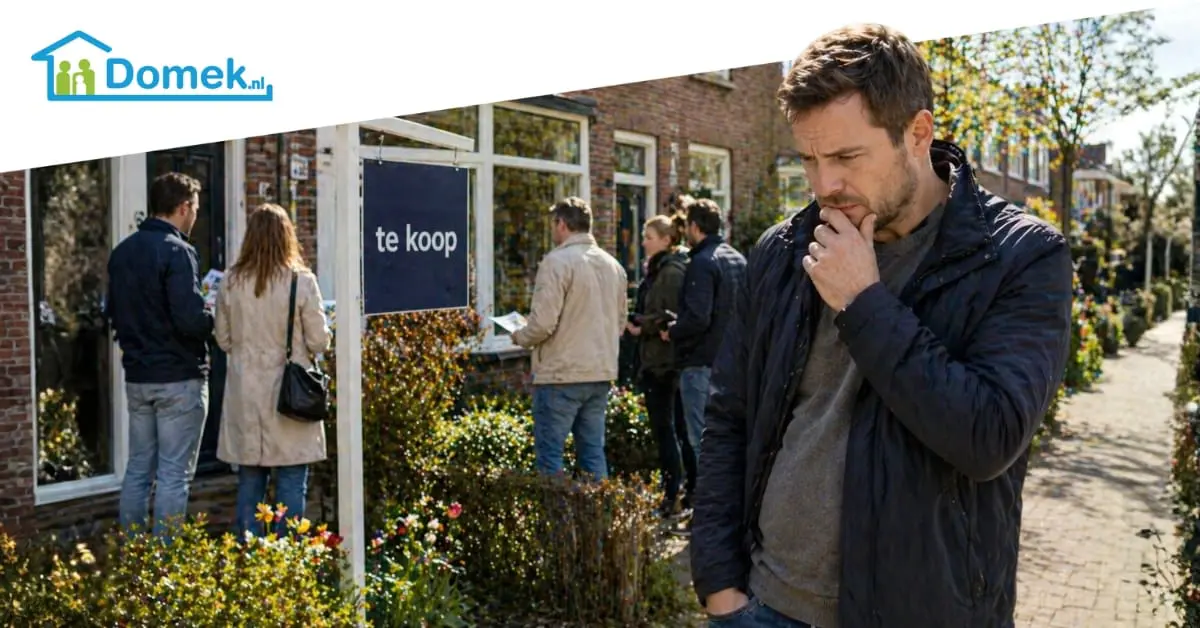
When a property goes on the market, interested buyers usually have a short period to schedule a viewing and decide whether they want to make an offer.
In popular areas, several buyers may be interested in the same house at the same time, so buyers often need to move quickly once the right property becomes available.
For many internationals, the Dutch bidding process feels unfamiliar and stressful at first. Proper preparation can make the process far clearer and more manageable.
Here is a step-by-step overview of how bidding works in the Netherlands.
Step 1: Do your research before the scheduled viewing
Before the viewing even takes place, it is smart to prepare yourself properly.
Find out your borrowing capacity, who the seller’s estate agent is, how offers should be submitted, and whether there is a deadline for bidding. In some cases, the property is sold through an invitation to tender system, where all interested buyers submit their best offer before a fixed deadline.
It is also important to research the value of the property and understand what makes a sensible offer in the current market. The asking price is not always the expected sale price, especially in competitive areas.
At Domek, we help you prepare even before submitting an offer. We calculate your borrowing capacity, explain your mortgage options, and help you understand what type of offer fits your situation.
Step 2: Be prepared to be evaluated
When sellers compare offers, they often look at much more than just the offered price.
They evaluate:
- mortgage certainty,
- financial preparation,
- flexibility around transfer dates,
- conditions included in the bid,
- and the likelihood that the sale will proceed smoothly.
Having Domek by your side strengthens your position during the bidding process. Seller’s estate agents see that your financial situation is well prepared and that the financing process is being handled by professionals.
Step 3: Resolutive conditions can protect you
One of the most important parts of a Dutch offer is the resolutive conditions (ontbindende voorwaarden). These are conditions that can protect you in certain situations.
For example:
- a financing condition protects you if you cannot obtain the mortgage,
- a technical inspection condition can protect you if serious defects are discovered,
- and other conditions may depend on your personal situation.
Some buyers remove certain conditions to make their offer more attractive. While this can improve the chances of winning, it can also increase financial risks.
At Domek, we help you understand the balance between making your offer attractive and protecting yourself financially.
Step 4: Submit your offer
If you decide to move forward after the viewing, the offer is usually submitted in writing through the seller’s estate agent.
Remember: Your bid is never only about the price. Include agreements connected to the purchase, such as:
- the preferred transfer date;
- financing conditions;
- any resolutive conditions you find appropriate for your situation;
- a technical inspection condition;
- other agreements, such as items that remain in the property after the sale.
Writing a short personal letter to the seller can sometimes help your offer stand out from competing bids.
In some situations, buyers only have one opportunity to place their best offer before the deadline. This is common in invitation to tender systems, where the seller reviews all offers at the same time and chooses the most attractive proposal.
At Domek, we help you prepare a competitive strategy, evaluate the financial risks, communicate with the seller’s estate agent, and have your financing ready before submitting the offer.
Step 5: What happens after your bid is accepted
If your offer is accepted, the next steps usually include signing the purchase agreement, after which you have a statutory three-day cooling-off period. After that, the mortgage process, required documentation, and notary arrangements move forward ahead of the property transfer.
This is often the stage buyers worry about the most. With Domek, you are never alone.
We prepare the process in advance, which allows us to quickly move forward with the mortgage application, communication with the bank, preparation of the required documentation, and organization of the next steps ahead of the deadlines, including the notary appointment and property transfer.
The all-in-one service for internationals
At Domek, we make arranging a loan or mortgage in the Netherlands simple and stress-free.
With more than 15 years of experience and a team of 100+ professionals, we help internationals understand their borrowing options, compare lenders, and find the solution that fits their situation.
Our advisors guide you through the entire process — from calculating your borrowing capacity and comparing offers to explaining the conditions and preparing the application.
If you decide to buy a home, we handle all the formalities — before the purchase, during the process, and after the property transfer.
Call us today at 088 1021 500, send an email to info@domek.nl, or fill in the contact form.